Total Pageviews

Showing posts with label jazz. Show all posts

Tuesday, August 12, 2014

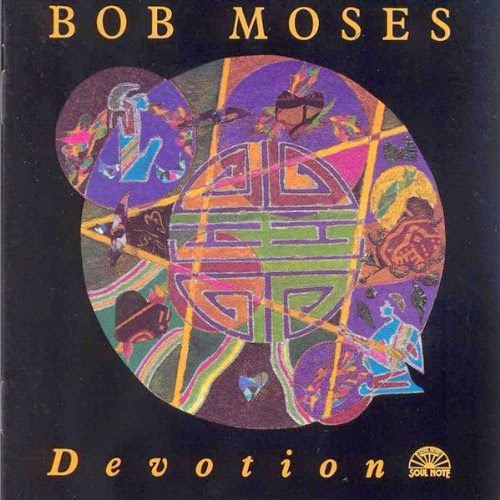
Bob Moses: Devotion (Soul Note 121173)

It turned out, somewhat embarrassingly, that five of the tracks on Devotion had been released already on an out-of-print 1980 LP titled Family on the small Sutra Records label. Soul Note learned this when a reviewer pointed it out. Within a few years, expanded use of the internet would make such an error much less likely to occur.


The band here is Moses (drums/percussion), David Liebman (soprano saxophone), Terumasa Hino (cornet, percussion), Steve Kuhn (piano), and Steve Swallow (bass).

Issuing the early work of a jazz musician 17 years after it was recorded carries with it a heavy burden of expectation and responsibility. The musician better be somebody of stature, or his historic document will be dismissed with a simple "so what?" or worse (anybody remember the critical reaction to Harry Connick Jr.'s album of his work as an 11-year-old? Ouch!) And the music better be of more than scholarly interest, or it will speak only to a small coterie. The tapes that Bob Moses's father found in his basement pass both these acid tests easily.

Multi-instrumentalist Bob Moses, born in New York City in 1948, was playing piano, vibes, and drums when he was ten years old and within two years was jamming with Charles Mingus, who was one of his press agent father's clients. He paid his dues as a teenage vibraphonist in the Big Apple's thriving Latin music scene and at the age of 18 formed what many consider the first electric jazz-rock group, Free Spirits (which included Jim Pepper and Larry Coryell). He subsequently played in a wide variety of jazz contexts with David Liebman's Open Sky, various Gary Burton groups, Jack DeJohnette, Pat Metheny, Hal Galper and the Brecker Brothers, and large groups led by Mike Gibbs and George Gruntz, among others. When Gramavision released 1982's When Elephants Dream of Music and 1983's Visit with the Great Spirit, they brought Moses critical acclaim and a broad audience. Yet he has recorded only intermittently since then, partly because he's been expanding his musical palette with trips abroad.

Thus, previously unheard music by Moses is even more welcome for mitigating the paucity of releases. But this album may be a revelation for those who know his music only from the later releases, which tend to be for large ensembles and of polyglot style. To say the quintet documented here is an all-star aggregation is not to engage in hyperbole, but merely to state the obvious. The talents of the players are given much more space than Moses's subsequent large-group works generally afford, and the context is at first glance more traditional, but the search for new sounds and structures found in the later works is already evident here; it's obvious at every turn that this was no jam session, but rather a carefully arranged date.

Thoughout this album, compositions unfold in a highly organic manner, with each section flowing into the next without obvious demarcations. It's as though, having decided that the tonal colors of the instruments and the styles of the players offer contrast enough, Moses wove his music from strands rather than building it from blocks. Jazz references name-check Gil Evans, Miles Davis, Charles Mingus, Duke Ellington, Thelonious Monk, and other bandleaders as influences on Moses's arranging, comparisons aiming obviously at Moses's large-group work; this quintet suggests that, structurally and developmentally, the subtle free jazz Jimmy Giuffre conceived in a trio format (to which Swallow was a major contributor) may have pointed towards some of the paths Moses travels down here, though the compositions are more worked out and a harmonic underpinning is almost always in evidence even if not always the governing feature.

"Autumn Liebs" is unsurprisingly a feature for Liebman, who solos first and longest; what is a surprise is that he's on tenor saxophone (as he is throughout the album) rather than on soprano sax. In fact, in the year following this recording he gave up tenor and flute to concentrate on the straight horn. His active (but not cluttered) style on this tune belies the accusation of Coltrane-clone often flung at his tenor work, covering a much broader bop and post-bop range in a thoroughly integrated way. Hino follows with a solo that seems ruminative even during its most expostulative outbursts and high-altitude moments; the longer it goes on, the more fragmentary his lines, lending a questioning quality, until Hino's phrases become so short that when Moses fills in the gaps with accents, it seems as though the two musicians are trading off. Kuhn's high-octane swirls follow in an effective contrast, and when the piece's hesitant theme returns, Kuhn underlines it with gusts and flurries.

"Heaven" is a ballad with an unusual structure: cornet and sax play the theme in unison, then repeat it with the tenor gradually diverging more to echo and comment. When Hino solos, Liebman continues to interject, as though the theme-and-divergence method were being continued, though by the second chorus it's Kuhn rather than Liebman who fills in the gaps. When Kuhn's solo begins, the effect at first is as if Hino has merely paused a bit longer. Kuhn's solo gradually becomes fuller, with his bright right-hand roulades balanced by weighty comping by the left hand, until Hino and Liebman return with the theme over Kuhn's most ornate runs. It is a highly organic arrangement that thoughtfully avoids the predictability and compartmentalization of head-instrument 1 solo-instrument 2 solo-instrument 3 solo-head structures.

The uptempo "Radio" has the merest excuse of a theme, its main characteristic being its asymmetrical phrase lengths and seemingly abrupt conclusion. In fact, it's a perfectly typical 32-bar length, but the ever-shifting phrase lengths with their unexpected pauses and extensions will throw listeners off-balance even on repeated hearings. Rising out of the absence of theme, Swallow steps to the fore for the first time, and then Hino plays his most fiery runs yet. The solos are not long, and after a typically bravura Kuhn excursion, Liebman charges in to top him. Throughout, Moses swings hard and fast, and after Hino spices the end of Liebman's solo, the theme gets played twice in a more assertive and less disconcerting fashion.

The oddly titled "Snake and Pygmy Pie" lays out a modal groove mostly carried by Swallow's ostinato pattern, with a sinister cornet/tenor melody full of pregnant pauses twining through Kuhn's spare Orientalisms while Moses plays a very free pulse. The textures are pared down even further when Swallow and Kuhn drop out, with Liebman and Hino trading figures which are more gestures than phrases, often overlapping, while Moses shifts the rhythm constantly. When the horns drop out, Kuhn and Swallow re-enter, both playing the ostinato figure, while Moses solos (a welcome change from the usual unaccompanied nature of drum solos). A lengthier and more elaborate variation on the style of the beginning turns into a coda that conjures the icy elegance of some of the quieter moments of electric-period Miles (a former employer of Liebman and an obvious influence on Hino, who on open cornet often manages to evoke a Harmon mute sound) with utterly different materials and procedures.

On "St. Elmo" (a reference to underappreciated bebop pianist/composer Elmo Hope, perhaps?), Hino finally does use a mute, recalling Miles's Prestige years. The piece seems continually to come to a close even in its earliest segments, yet keeps starting up again. The gorgeous ballad features Hino for quite a while until Kuhn takes over briefly with a strangely swirling line in which every accent is placed with lapidary precision, like Monk playing a Bill Evans tune. The oddly coda-like character of the entire piece, with Liebman entering late and Hino's fragile tone so predominant, leaves an elegaic impression at the same time it continually unsettles expectations; when it finally does cease to start up again, the effect is breathtaking.

The speedy "Portsmouth Figuration" has another odd, and quite short, head, with a few note-filled snippets of varying lengths alternating with brief, frenetic solos, with Swallow's trotting (this is too fast for walking) and Moses's headlong rush of a cymbal beat holding it together. Hino again plays fragmentary lines during most of his short solo, contrasting strongly with the robust, perpetual-motion lines Liebman spins out next. Moses then takes an unaccompanied solo of JATP-like proportions, shifting kaleidoscopically through a variety of patterns spiced up with some percussion sounds definitely not found in a standard drum kit. Through all the pauses and twists, his momentum never flags until he fades out before the oh-so-brief reappearance of the instruments.

The melody of "Christmas '78" is awfully nostalgic, in a fairly melancholic if hardly depressed tone, for a holiday a mere eight months past at the time of recording. Though Kuhn's comping under Hino's solo, along with Swallow's rhythm, is sometimes quite jaunty, it alternates with a foreboding modal pattern utterly lacking in cheer. Hino's improvisations here are much more of a piece than elsewhere on the album, and within a relatively narrow range. Similarly, Kuhn's solo is at first more restrained and less overtly virtuosic than his established norm on the other tracks. He takes us through a series of juxtaposed moods ranging from chirpy to ironic, all seemingly with quotes around them. Liebman's pensive, Shorteresque solo has an elliptical quality that leads into a unison restatement with Hino of the regret-laden theme.

Hino opens "Devotion" by himself in his most heart-wrenching tone, developing the nagging motif with some mildly avant timbres before returning to his plushly mellow tone. Swallow takes over with a minimal, broadly paced ostinato just barely accompanied by Moses, leading finally to the theme. A regal melody laid out in long notes, it has a flavor of archaic majesty to it that all the players emphasize as they simultaneously embroider it, slowly crescendoing in volume and intensity. The title helps suggest a sort of ritualistic worshipfulness, and the ever-increasing fervor of the players suggests this devotion brings with it an ecstasy surpassing verbal expression. Kuhn in particular utterly submerges his florid tendencies in a chiming procession of block chords. The bends and tonal inflections of Hino and the plangent, mournful sound Liebman draws from his horn, which eventually is stripped down to a long held tone, give way to Swallow's final statement of the ostinato and then to silence. It is the most organic and elliptical of all Moses's arrangements on this masterful session, and its hushed rather than bravura ending, like all of them, heeds conventional ideas only to quietly subvert them. Here's hoping Richard Moses finds some more tapes in his basement.

Monday, August 11, 2014

The Albert Ayler Story (ESP4072)

Something current, for a change. This accompanies a download-only July 2014 release with four disc's worth of tracks, mixing music and interviews.

Albert Ayler, one of the most controversial and polarizing musicians in the history of jazz, was accused of not being able to play his instrument, so radically did he reboot the whole idea of jazz saxophone. But consider this: in his youth in Cleveland, he was nicknamed "Little Bird" for his ability to mimic Charlie Parker, and later such old-school tenorists as Don Byas and Illinois Jacquet praised Ayler's playing.

The son of a saxophonist, Ayler was born in Cleveland on July 13, 1936, and from an early age was attracted to music. His father gave him his first lessons, starting him on alto sax. After excelling in both school and church bands, Albert began playing in professional bands in his mid-teens, famously being recruited for the band of blues harmonica great Little Walter Jacobs, who took him on tour. Ayler spent two years in Jacobs's band and also went on the road with New Orleans R&B singer Lloyd Price. At age 22, he joined the Army and was assigned to a Special Services band (an example of his playing in this context is included here), which basically meant he was still being a professional musician while he served for three years (and on top of that, he could take gigs in nearby Louisville). Eventually, he was posted to France, and also got to visit Denmark and Sweden.

During his time in service, he switched to tenor saxophone and began working on developing a more personal and revolutionary style. When he returned to the States, the change shocked old acquaintances. He was discharged in 1961, at which point Ornette Coleman had become notorious for playing microtonally and ignoring chord progressions, but Ayler went even farther into free improvisation. Faced with rejection in his native land (not only in Cleveland, but also during a brief sojourn in Los Angeles), Ayler returned to Sweden in April 1962.

He was out of place there too, playing with musicians who didn't fit his new style, but it's nonetheless historically fascinating to be able to chart his growth by listening to his June 1962 radio session in Finland, as guest with a band led by Swedish guitarist Herbert Katz – the first recorded example of Ayler's new approach. His rendition of "Summertime" brings to mind clarinetist Tony Scott's anecdote about a time, years later, when Albert sat in with his group and played the same tune: "…he went way out, you know. I turned to [fellow clarinetist] Perry Robinson and said, 'Does he know "Summertime"? He said, 'Forget that and listen to what he's playing!'" Ayler also sometimes got to play in the company of more adventurous and empathetic compatriots, notably with the Cecil Taylor Quartet the following month, as heard on an excerpt here that focuses on Albert's solo amid a free improvisation. By the time he left Europe and returned to the U.S. in 1963, he had recorded two albums, though again with relatively incompatible local sidemen.

When he returned to his home country, it was not to Cleveland, but to the center of the jazz world: New York City. Near the end of 1963, a friend of Ayler's urged Bernard Stollman, a lawyer who occasionally helped musicians, sometimes for no recompense, to go uptown to Harlem to hear Ayler sit in on an Elmo Hope gig. When Ayler got up to play, the other musicians stopped playing, but Ayler was used to such behavior by this time; it never stopped him from playing, and he played solo for twenty to thirty minutes. Stollman was overwhelmed by the intensity of Ayler's music. Earlier that year, Stollman had issued an album of music and poetry, Ni Kantu en Esperanto, to promote the constructed language Esperanto, of which Stollman was an enthusiast; he had named his label ESP for that reason.

Stollman's enthusiasm for Ayler's music led him to immediately propose issuing an Ayler LP. Ayler said he already had a session scheduled for the following February at Atlantic Studios (these recordings were eventually issued as Witches & Devils [AKA Spirits] and Swing Low Sweet Spiritual [AKA Goin' Home]), but that he would be in touch after that. To Stollman's surprise, Albert kept his promise. He had put together a trio with bassist Gary Peacock and drummer Sonny Murray that meant he was playing regularly with like-minded innovators, so their July 10, 1964 session went well, to say the least. In fact, it was a milestone of jazz. It would not be much of a stretch to say that ESP-Disk made Albert Ayler famous and Ayler made ESP famous. Ayler had impressed a few colleagues on the avant-garde jazz scene, but was little known before 1965, when ESP released his album Spiritual Unity, the label's first album of jazz, recorded at that 1964 session.

Spiritual Unity presented a new paradigm for improvisation. Not even Ornette Coleman's groups played with so little structure, standard pitch, and steady rhythm. Even Ornette had a system; Ayler ran on pure, unbridled emotion. Ayler's sound was so unprecedented, and so much rawer than any other jazz of the time, that poet Ted Joans famously likened it to "screaming the word FUCK in St. Patrick's Cathedral." Sometimes, it was expressed in squalls of untempered sound, sometimes in outbursts of poignant spontaneous melody. Meanwhile, under and around the leader's effusions, Peacock and Murray reinvented the roles of their instruments. Spiritual Unity ranks among the most influential 29 minutes on record in jazz, and "Ghosts," "The Wizard," and "Spirits" became familiar touchstones of "The New Thing," as this revolutionary musical movement was dubbed.

ESP followed up this success with many Ayler releases, some years later – more than by any other artist on the label. Three more 1964 recordings eventually appeared on ESP. Prophecy documented an earlier (June 14) trio performance at the Cellar Café in New York with, aside from the title track, the same repertoire as Spiritual Unity, but more loosely organized. It was recorded by Canadian poet Paul Haines.

The soundtrack for the art film New York Eye and Ear Control was recorded seven days after Spiritual Unity; it was a free improvisation for which Ayler's trio was joined by trumpeter Don Cherry, alto saxophonist John Tchicai, and trombonist Roswell Rudd. Even freer than Spiritual Unity, it's been called the link between Coleman's Free Jazz and Coltrane's Ascension. It is certainly not an iota inferior to Spiritual Unity, and the interaction with Cherry has led some to rank it even higher.

Another Ayler/Cherry collaboration that didn't appear until many years later, The Hilversum Session, was recorded at the end of a European tour with Cherry, Peacock, and Murray for a Netherlands radio station. It has not been blessed with the reputation of Spiritual Unity because of its tardy release, but it is just as boldly brilliant, the culmination of their year's work. We also sample a gig from earlier on that tour, this time without Cherry.

1965 yielded Ayler treasures as well as his style shifted. The transitional Bells was just 20 minutes (here we sample the beginning], released originally as one side of a clear vinyl LP with the other side. It was recorded at a May 1 Town Hall concert of ESP artists, displaying Ayler's new group. Murray remained, Albert's brother Donald joined on trumpet, and Lewis Worrell held down the bass slot. The denser sound of "Bells" shows Ayler moving towards the bigger sonic statement made on Spirits Rejoice, a September 23 Judson Hall session (ESP used the empty concert hall as a "studio," its reverberation adding to the bigness of the sound). Albert and Donald were joined in the frontline by Charles Tyler on alto sax while Peacock paired with fellow bassist Henry Grimes, with Murray a constant. Both Ayler's playing and the band sound are even more intense than before, the parts of the players sometimes only loosely related. Some defended it as an energetic ensemble style harkening back to the early days of New Orleans jazz in its intertwining of independent lines; it came to be called "energy music" and started a movement that continues to the present day in the playing of Charles Gayle, Sabir Mateen, and Peter Brötzmann.

In 1966 Ayler was signed by the Impulse! label, but a pair of LPs recorded at Slug's Saloon that May 1 was released by ESP many years later. It showcases Albert's regular group of that time: Donald, violinist Michel Samson, Worrell, and drummer Ron Jackson, AKA Ronald Shannon Jackson, continuing Ayler's run of superb, innovative drummers. The less-than-hi-fi sonics pale to insignificance in the face of the sheer power of the performances. A few non-Impulse! concert performances from '66-67 further extend our view of Ayler's evolution.

When Ayler's band went through Customs in July 1970 on their way to play at a festival in France, keyboardist Call Cobbs got held back and arrived a day late. Minus Cobbs, the band played anyway. The music-making of the resulting ensemble is freer and more adventurous than on the quintet's following Maeght Foundation concerts. This unique document, Ayler's penultimate recording, thus brings him back to something close to the trio setting in which he first found fame. Bassist Steve Tintweiss (who decades later brought his cassette tape of the concert to ESP) and drummer Allen Blairman are sometimes joined on Live on the Riviera by Ayler's partner Mary Maria, who adds occasional vocals and, once, another sax. Exactly four months later, Ayler's body would be found in the East River.

To dwell on how small Ayler's recorded repertoire was, and how often his bands recorded the same tunes, would be to miss the vastly larger point that the playing of both Ayler and his band mates was of such great spontaneity and imagination that no two performances are remotely the same beyond their themes. Ayler's influence at the time and for decades to come was based on his ESP records much more than his work for any other labels (yes, we're biased, but we're hardly the only ones who think that), but given the briefness of his career, every recording of Albert Ayler is precious musically and spiritually.

Richie Beirach - The Snow Leopard (Evidence)

The Snow Leopard is a 1997 trio record with George Mraz, bass; Billy Hart, drums; plus Gregor Huebner, violin, on a few tracks. This is one of my favorite notes. I always find it more interesting to talk with the artist about the album, and Mr. Beirach was very friendly and open during an afternoon in his apartment. In particular, his earlier Blue Note recording of the first piece in Musica Callada by Federico Mompou had been my introduction to Mompou's music, and talking about Mompou with him strengthened my desire to track down all of Mompou's recordings of his own piano music.

Thanks also to Jerry Gordon of Evidence Records for the assignment. It was the first liner note job I got from a label other than Black Saint/Soul Note, where I had worked for several years.

Over the course of Brooklyn-born pianist Richie Beirach’s long and respected career, he has never made an album as full of variety as The Snow Leopard. “I wanted to do something that I hadn’t done before,” he explains, “and that had always previously been a problem and dangerous, [which] is to bring together very disparate, seemingly stylistic possible clashes. It’s one of the things that I’m always very aware of making a record, that you don’t just put a bunch of tunes on it--you don’t have to have a big concept either--but the way music dovetails into each other is very important, and it’s ultimately more important than the actual content. Some of the music on The Snow Leopard is straightahead in a sense, like that tune "Citizen Code," that’s swinging, and it’s tonal. And then to do something like the Bartok duo, which is completely different language, different instrumentation, and contemporary music. It just happens that I really enjoy doing all those different things. I usually do them on separate albums. Putting these things together, I just wanted to give myself a challenge, surprise the guys I’ve been playing with for 20 years, and hopefully come out with some fresh things as a result of different combinations.”

Though Beirach didn’t think it all out beforehand, he does have strong feelings about how the different items balance each other, and how the sequence flows. “In terms of chromatic or tonal or simple harmonic [language], the intensity of the Bartok piece is very similar to "Redemption," except that the instrumentation is different. We also do "Peace Piece," and that is very stark because it’s pure C major. "The Wee Small Hours," you know, a standard, Frank Sinatra, is very dark. I mean, the tune is in major, I put it in A minor instead of C major. I saw that as a balancing act to "Naima" and "Peace Piece." For me what is the difficult thing to integrate is not the playing, it’s the harmonic language, and then the rhythmic phrasing. See, the rhythmic phrasing in "Naima" [is] very, very, not conservative, but accessible. We’re not slipping around over bars disguising it very abstractly. You can count it. I wanted that. Whereas "Redemption" is like a volcano.”

One of the reasons "Redemption" stands out is because it comes right after "Expression." “Now the reason I put them together, "Expression" was Coltrane’s last tune. If you listen to Coltrane’s recording of it, they play the head with Alice and Rashied, and then they go off and scream. They don’t ever use the chord progression, even rubato. I realized when I saw the tune, that the tune is so important, because it combines a lot of Coltrane’s tunes from the past. It has like "Giant Steps" kind of movement in a ballad, like major third root movements. Melodically, the way the notes fall on the chords are very, very tonal, they’re right in the 1-3-5-7 of the chord. The harmony moves, it’s very thick, it’s almost like an old-fashioned ballad the way the harmonic movement is so rapid. Because [later] Coltrane had basically simplified his chord progressions down to one or two chords. He eliminated all the rapid chord rhythm. So I played the tune and it was such a strong piece of music, it was almost operatic, it was like Tosca, an aria. And then I got into the chord progression, I learned to play it through the changes, which nobody has ever done. First I was going to play it solo piano. No. It was too like Rachmaninoff. Then I realized, I’ll play the head, play through the changes like Trane does, but I’ll play on the changes after. In other words, I’ll go back and play from chord to chord. It worked because of George, harmonically, because I’m so linked with him; [and] that’s Billy’s favorite stuff, the free rubato stuff. And if you listen to the way Billy plays on that, there are very few drummers alive that have that kind of imagination. At the end melody, we’re sweeping along and it’s really rubato. He starts playing very soft but very consistent double-time. It had nothing to do with what I’m doing, but when you listen to the whole thing together, it creates a whole other dimension, because he’s doing like a texture superimposition thing. He’s doing what’s not being done. The reason I put "Redemption" after that is because Coltrane was Billy’s thing--he played with him once or twice, I think--and that tune, that’s like a Trane tune, isn’t it? Maybe [from] Transition, harmonically.” The interviewer suggests Blue Train. “You’re right,” Beirach responds, “because what I do in it, I don’t play on one chord, I move it to an eight-bar blues thing. But that was more consistent with "The Snow Leopard," and the Bartok, the language of it.”

This is the second time Beirach recorded Federico Mompou’s "Música Callada No. 1" (he did a solo version on Sunday Songs). “I discovered Mompou through a student,” he recalls. “A student went into the Tower Records discount bin, like a big barrel for a dollar, and she just saw this nice old man’s face on a CD from Spain. The guy lived to be 97, he just died 10 years ago. Alicia de Larrocha was the original tape that I heard. The music was so deep and simple and reminded me so much of the best of Bill Evans, or the way Keith [Jarrett] would play early on, no excess. It had that sense of concentration, those pieces. ["Música Callada No. 1" is] perfect for improvisational format, because it’s so simple. It looks like a lead sheet! It’s some of the deepest music, and a challenge to play. There’s no place to hide. You can tell he spent his life on one note here, one note there. So that appealed to me, because of simplicity and transparency, to use it as a format for improvisation. It kinda felt like it was one of my tunes, or something from Sketches of Spain.”

Beirach also returns to some of his own tunes on this album. “I recorded "Elm" a lot. Elm was originally a record on ECM which was never distributed here, with George Mraz and Jack DeJohnette. [Elm also includes "The Snow Leopard."] I recorded "Elm" also with Quest. I wrote "Elm" as a dedication to a wonderful Polish violinist named Zbigniew Seifert who I was friends with and who I recorded some stuff with. Very unknown, very tragic. He died of cancer [at 33]. That tune, I didn’t write, it just, there it was. It came as a gift, intact. People seem to be drawn to it because there’s something very basic about it, it sounds like it’s always been there.”

The melody of "Citizen Code" is also an interesting story. The chords are based on the standard "The Lamp Is Low," and Beirach changes the original melody by playing it quite abstractly. He points out, “The guy that wrote it stole it from Ravel. It’s Ravel, 'Pavane for a Dead Infant.'” It’s no surprise given the song’s Impressionist roots that Beirach was attracted to it. By the way, he explains the title thusly: “[Producer] Todd [Barkan] thinks I look like a young Orson Welles, like Citizen Kane. And Code is my nickname for years, people call me The Code.”

Fortunately, Beirach’s musical code is so emotionally communicative that no matter how complex its harmonies and rhythms, it’s easily understood. With so many facets of his style in one place on The Snow Leopard, it’s practically his Rosetta Stone, simultaneously a summary of his musical growth and the perfect introduction for new listeners. Like the title animal, Beirach’s music is rare and beautiful and worth preserving.

Sunday, August 10, 2014

Billy Bang: A Tribute to Stuff Smith (Soul Note 121216)

The first album note I ever wrote came about by accident. I worked at Black Saint/Soul Note in the early '90s, when it had a New York office (in the cargo area of JFK Airport, oddly, though since they were importing from Italy, it was somewhat convenient, though certainly my commute was far from convenient). When violinist Billy Bang was scheduled to record an album that Sun Ra would play on, you can be sure I went to the studio.

This turned out to be Sun Ra’s last studio session. It was certainly a pleasure and a privilege to be on the periphery of it, but also somewhat trying. This was after Sonny's stroke, and he was confined to a wheelchair by then, and I'll never forget helping his manager get him out of the cab outside Sear Sound and into the chair while just down the block where a prostitute had been giving a blowjob in clear sight on the sidewalk, a fight broke out between the pimp and the john and they were breaking glass bottles with which to do battle, close enough to us that shards of glass were skittering under the wheelchair. Nor will I forget the totally unrehearsed recording session, with Sun Ra and Bang reconciling differing ideas of how various songs should be structured (as Bang discusses freely above). With Ra's ability to communicate severely impaired post-stroke, the first day proceeded at a crawl, and it was somewhat amazing that it all came together and good music resulted.

Somebody in his camp was scheduled to write these notes, but ended up being too busy dealing with Sonny's health issues (he would die within a year). So, since I was the only Soul Note employee who had attended the session whose native language was English, I got the job. Thanks always to Flavio Bonandrini for taking a chance on me.

In a radio interview back in 1987, Billy Bang was already talking about planning a Stuff Smith project, and if it turned out to be a smaller group than he originally imagined, one statement was still prescient: "It's individual identity that is one of the most important things. When I get this project together I'll be playing the music of Stuff Smith, but when you hear it you'll know it's Billy Bang playing Stuff Smith."

One jazz reference book includes the information that Bang's violin technique had to be corrected because he'd copied Smith's unorthodox way of holding the instrument. Despite this, Bang arrived at his own unique, sweetly acerbic, freely swinging sound. Study with Leroy Jenkins corrected the technical problem, and listening to saxophonists such as Jackie McLean (an obvious tonal influence on Bang) and Ornette Coleman gave Bang a foundation on which to build his own improvisational style. Conscious of what's gone before, he respects it too much to merely imitate it, in the end reflecting the spirit of the original creators. He certainly sees the linear progression. Bang says of Stuff Smith, "He was avant garde too, in his own way.... By the nature of his instrument, basically. People still don't understand the notes of Smith or can catch on to him. He was so far-fetched, so far away from jazz. Not for the main people, not for the people that are inside, but even for people that are in my neighborhood [Bang grew up in The Bronx]. I had never heard of Stuff Smith. It took me a long time. You would hear Papa John Creach before you'd hear of Stuff Smith. You would actually hear Ray Nance before you'd hear Stuff Smith. So he was outside of that medium, somehow."

Smith's career certainly did not follow a mainstream path. Born Hezekiah Leroy Gordon Smith in 1909, he became known in the 1920s but only achieved fame after some 1930s recordings with his Onyx Club Orchestra featuring his comic vocalizing struck the public fancy. This seems to have led to critics not taking him seriously (Louis Jordan suffered much the same fate), and Smith is often left out of jazz reference books. Those that do mention him, however, are properly respectful of his violin skills and even seem aware of how far ahead of his time he was, instrumentally and musically; one book refers to "cross-beat multiplications" as an integral element of his style.

Now having finally recorded his Stuff tribute, which had shown up onstage before being committed to tape, Bang says, "It was a great opportunity for me to get a chance to showcase how I feel and how I can handle a traditional song but still 'a la Bang,' because I hear these same songs played, like `Satin Doll,' by a million different guys, and basically to me they all sound the same: the same clichés or solos, the same licks, the same turnaround. I anticipate what's going to happen and sure enough, it happens. I try to approach it through what I believe and how I interpret it, but still sticking to tradition. The chord changes are the same, bridges, 32 bars, etc., etc. So it's really pulling two different sides, two different angles together, and what really enhances that is being able to do it with Sun Ra."

When it came time to go into the studio, Bang knew who to call in as the perfect foil. He says the presence of Sun Ra functioned "like a physical passing of the baton, and it's like a real physical touch thing--Sun Ra played with Stuff Smith. And I have no connections over there, emotional and musical and all that. And to be playing with a person who played with one of my heros...it's like a real type of a bond. And actually to play one of the same songs that Sun Ra played with him, caught me by surprise, because I didn't know whether we were gonna do that or not. I came back from lunch and saw it on my music stand, 'Deep Purple.'" Ra's collaboration with Smith on that standard can be heard on Evidence Records' CD reissue of Sound Sun Pleasure as a bonus track. Believed to be the earliest recording of Sun Ra yet released, it was probably laid down in 1953 or '54 in Ra's home.

John Ore and Andrew Cyrille were hardly afterthoughts in the quartet; both have famously served time playing for strong-minded pianists, Ore with Thelonious Monk and Cyrille with Cecil Taylor. Ore has since played with Ra, too, and Cyrille and Bang have frequently teamed, so this session group had a headstart in cohesion.

Bang himself has played in the Sun Ra Arkestra, if not as soon as he could have. After he finished his tour in Vietnam, Arkestra member Jack Jackson tried to get Bang to join. Having just gotten out of one army, Bang did not immediately jump into another sort of army. Eventually, though, he did join the Arkestra and don the robe and headpiece; he has photos of himself thus attired, playing electric hollow-body violin with the Arkestra in 1981. That experience, although different from playing with Ra in a small group, helped prepare Bang for this session.

"I only played with Sun Ra in a big band. But now I'm faced with Sun Ra at one-on-one, almost. And that did put a lot of weight on me. I always knew how deep Sun Ra is. He comes out of an era I know nothing about, his voicings, everything. He was playing some Scott Joplin, too. So luckily I had been around Sun Ra enough to get enough courage and confidence up to deal with him directly. It was one of the most profound things I had to do musically. It's kind of like being a gunslinger going one-on-one with Ra. He knows what he's doing. I'll give you an example. There's one song called `The Bugle Blues' that has that trumpet intro, but Stuff Smith played it on violin. They used to play that record in Chicago and Detroit to wake people up in the morning on radio stations. Right there [at the end of the intro], for me, was the top of the song. That was the intro, detached from the song. What Sun Ra did was, he definitely counted that introduction, four bars, and when we came in on one, that was the fifth bar. He wasn't going to hear anything else. He had the first solo, so when he hit the top of that bar, which was the fifth bar, then he played up to twelve bars, eight more bars to play, then we're back to the top. So he wanted to go from five to twelve, then from one to twelve. We took a long time, but when we finally figured it out, he was correct. And that's the kind of person he is, that's what he is.

"On some other songs," Bang continues, "I thought he was bringing in the bridge a little too soon in some places. But then I realized later that that's really Sun Ra's style. Because the first time I heard him was this church in Washington, D.C., the first time I really heard Sun Ra play with the time, it was there, but he was kind of in his own time frame. But the thing is, what I had John Ore do was keep counting with us and come right in. So sometimes we came in before he finished his statement, because I wanted to really maintain the structure. Somehow it didn't hurt the structure for him just to be Sun Ra. That's why I had to really utilize confidence and courage, because normally I would allow Sun Ra to finish his statement, and wherever he ended, I would come in, wherever that is. It might not be the first bar at the top, it might be the third bar. But I didn't want to give that much room up, for the sake of the music. So it was kind of push and pull, the whole thing, but it was done in such a mellow way that it was a kind of a non-antagonistic appreciation of that. And it's always been that case for Sun Ra, even when I'm in the band, always. You've got to respect him."

On this recording, Sun Ra showed he had adjusted to playing in the wake of his stroke, deploying Monkish chords and finding complexity in simplicity during his solos. Listen to the first Ra solo of the album, on "Only Time Will Tell." Almost any pianist could play it--but only Ra would think of it. And while comping under Bang, Ra turns the music inside out with his off-kilter rhythms and harmonies. Bang is hardly overshadowed, spinning out inventive yet swinging, structurally sound lines. With Ore's fat bass sound and Cyrille's pointillistic drumming providing a rock-solid but supremely flexible rhythm section, the liberties Ra likes to take are perfectly supported. The one-of-a-kind results speak for themselves.

Gaslini Plays Sun Ra (Soul Note 121490-2)

Sad news from Italy earlier this week: the great Giorgio Gaslini passed away. Here are my booklet notes for one of his albums:

Over the course of his long and fruitful career, Italian pianist/composer Giorgio Gaslini has taken on some daunting musical challenges and emerged with shining success. This is, after all, the man who previously released a solo piano album of Albert Ayler pieces (Ayler's Wings, Soul Note 121270); the man who jazzed up Robert Schumann with trio arrangements (Schumann Reflections, Soul Note 121120). And, although it was less startling, he's the man who recorded an album of solo Thelonious Monk (Gaslini Plays Monk, Soul Note 121020) back in May 1981, while Monk was still alive and such tributes were less common. There's also Gaslini's big band arrangements of Jelly Roll Morton (Jelly's Back in Town, DDQ 128020), not to mention operas based on Othello and the life of Malcolm X. The dapper Italian maestro is, in short, a man of imagination and creativity not only in his own considerable music but also when playing other people's music, even when their strong personalities would overwhelm those of most other musicians.

Certainly Sun Ra, AKA Le Sony'r Ra, AKA Herman Poole "Sonny" Blount (1914-1993), was one such original, one of the most distinctive, innovative composers and performers in jazz -- a genre overflowing with strong personalities. Gaslini's way with Ra's music is sometimes whimsical, but never capricious; he takes it seriously, yet never sounds academic. The paths of these two musicians from different worlds (the Deep South of the United States, the North of Italy -- or, as Ra would have it, from Saturn and Earth) intersected on the physical plane twice, both festivals when Gaslini's group played the first set and Ra played the second set. The first time was on Gaslini's home turf in 1973 at the very first concert in the history of Umbria Jazz in Perugia; the second time was in 1987 on Ra's old stomping grounds, at the Chicago Jazz Festival.

A stronger link than having met twice is their insistence on making music that, though it comes from strong roots, is allowed to flourish without boundaries, to expand beyond mere genre (like Gaslini, Ra would occasionally translate classical pieces into jazz). One of the most startling expressions of that phenomenon on the present set is the way Gaslini interpolates bits of The Well-Tempered Clavier of Johann Sebastian Bach (1685-1750) into each of the tracks. One connection between Bach and Ra could be the importance of counterpoint in their musical conceptions, however differently expressed; another is that both built their art on foundations considered obsolete by the time they found fame. While the streamlined style galant bloomed around him (even his own sons preferred it), Bach continued expanding the learned counterpoint of older generations. Famously, when he played for German organ patriarch Johann Adam Reincken (1643-1722), who had studied with a student of Jan Pieterszoon Sweelinck (1562-1621), Bach improvised on the same chorale tune as Reincken's famed showpiece, the Fantasia on "An Wasserflüssen Babylon," leading the elder to exclaim, ""I thought this art was dead, but I see that in you it lives!" Sun Ra's Arkestra, though pegged as avant-garde, could and did play note-perfect Fletcher Henderson swing arrangements decades after swing was considered an anachronism. A final link is found in Gaslini's statement, "I found a special similarity between the cosmological conception of Sun Ra and the metaphysical vision of J.S. Bach. It was for me a spontaneous connection." More on that in a moment….

This is just Gaslini's third solo piano album. As he did with Ayler's music, Gaslini made transcriptions from Ra's band recordings (he has not chosen any pieces that  Ra made solo piano recordings of), then arranged them for piano, as he puts it, "preserving the purity of the original themes and seeking to capture the harmonic and polyphonic physiognomy that were so often implicit in the composer’s orchestral versions." Gaslini professes to find "a surprising sort of modern 'classicism'" when Ra's arrangements are thus clarified, a "tendency towards objectivity" that is emphasized even more when set alongside the Bach fragments. On about two-thirds of the tracks, the Bach quotes are easily heard; on the rest, they are harder to catch.

When, as Gaslini says, "the earthly metaphysics of Sun Ra are set beside the serene metaphysics of Bach," it is worth pondering what those metaphysics are. Both composers, whether despite or because of their great rationality, also had a strong strain of mysticism. In Bach, this apparently found some expression in his music through number symbolism; the pioneering research in this aspect of his creativity was done by German scholars Arnold Schering, Martin Jansen, and Friedrich Smend. While interpretation of this symbolism ranges from the innocuous to the extreme, there seems to be some core truth to it. (Ruth Tatlow's article in Oxford Composer Companions: J.S. Bach, edited by Malcolm Boyd, concisely summarizes the methods, provides examples, critiques the results, and delineates the controversies surrounding the use of number symbolism in Bach analysis.) Numbers strongly associated with Christian faith -- 3 for the Trinity, 10 for the Ten Commandments, 12 for the disciples, Psalm numbers, etc. -- mingle with word conversion through use of gematria (application of a number alphabet: A=1, B=2, etc.). Thinking of this as riddles or secret messages embedded in the music misses the larger point; it's a way of making the structure of the music reflect its overt message, making it a holistic reinforcement rather than a hidden meaning. The focus of numerical symbolism research in Bach's music was long on his church works, but more recently, Helga Thoene has posited codes in Bach's solo violin sonatas, not only numerical analysis but also obscured quotations of chorales with strong emotional content; chorale quotations pop up in instrumental contexts in other Bach works as well, including The Well-Tempered Clavier. Ra also referred to earlier religious music in his own works; some of the Arkestra chant-songs can be partially traced back to spirituals.

Bach's otherworldly outlook came directly from his strong Lutheran beliefs, at least partially touched by the Pietist movement and its incorporation of the strains of mysticism  found in much earlier writers such as Bernard of Clairvaux and Thomas à Kempis, influences on Luther himself. (However, Bach was definitely not sympathetic to the Pietist opposition to concerted music in church services!) Sun Ra's mysticism -- perhaps better characterized as his highly personalized way of reinterpreting the world -- came from a wider variety of sources. A telling glimpse comes from the Spring of 1971, when he taught an Afro-American Studies course at Berkeley (as pithily described by John F. Szwed in his invaluable Ra biography, Space Is the Place: The Lives and Times of Sun Ra). The course was called The Black Man in the Cosmos; the reading list included The Egyptian Book of the Dead; David Livingston's Missionary Travels and Researches in South Africa; the King James Bible (which on the syllabus Ra called "The Source Book of Man's Life and Death"); P.D. Ouspensky's A New Model of the Universe; Yosef A.A. Ben-Jochannan's Black Man of the Nile and His Family; Frederick Bodmer's The Loom of Language; and a host of others, many even more esoteric. For the students to track down much of the list was a nightmare.

The Bible was a constant reference for Ra throughout his life, but his attitude towards it shifted to a belief that it required radical reinterpretation through permutation of passages into new meanings, sometimes the opposite meanings from what were ordinarily imputed to them. In effect, Ra was a modern-day Gnostic preaching that the world we live in is a world of illusion; he was fond of saying things such as, "I'm talking about space; I'm talking about not being part of this planet, because it's not proper," and, "This world is not my home. My home is out there." Compare this to the Lutheran sentiments in so many Bach cantatas: sin corrupts this world, and death is a passage into new and better life. Of course, to try to force too great a correspondence between Bach and Ra is unproductive, but the parallels are definitely there. Ultimately, there's no reason to try to prove a connection that's not a matter of fact, but rather intuitive and metaphorically enriching. Similarly, one need not be fluent in gematria to enjoy the contours of Bach's music.

Nor, for that matter, would a listener have to know any of the above to enjoy this album. Maestro Gaslini has constructed a varied program of Ra rarities and familiar items. "Out in Space" and "A Quiet Place in the Universe" exist, as far as is known at this time (certainly plenty of concert tapes continue to pop up) in only one version each, both recorded "live." Then there are pieces that perhaps existed only in the studio. "The Perfect Man" is an exceptional case, originally released only on a single. It's seemingly an unlikely candidate for this sort of tribute, an oddball attempt at pop that's peripheral to Sun Ra's jazz legacy aside from its use of synthesizer, on which Ra was a jazz pioneer. Gaslini can't duplicate the textures on a piano, but he largely keeps to the use of more vernacular style, especially boogie-woogie, with another Bach interpolation (with similar motion and rhythm, however) and an eruption of free playing just before the end. "When Angels Speak of Love" (Gaslini wonderfully captures its quirky, off-kilter lope), "Kingdom of Not," and "Lanquidity" are the other unique items chosen for this album.

"Yucatan" was released on only one album, Atlantis, but exists in two versions because when the album, first on Ra's own label, Saturn, was issued on the Impulse! label, a different tape was substituted. Gaslini ends his arrangement with a brief Bach quote that rhythmically matches the drums at the beginning of Sun Ra's versions, most closely the Saturn. "Satellites are Scanning" is the same piece as "The Satellites are Spinning," merely mistitled on the Enja album Destination Unknown that documents a March 1992 concert. But, of course, that's not to say that "Satellites are Scanning" sounds the same as "The Satellites are Spinning." The arrangements are really quite different, partly because the recording of "Scanning" dates from Ra's post-stroke period, when his left hand was greatly weakened. Gaslini's arrangements are also considerably different from each other. "Spinning" is noteworthy for several Bach insertions that move in and out in the tightest Bach/Ra integration of the album; they're themes that inherently suggest spinning. The first is soon dovetailed with Sun Ra's theme in a sensually and intellectually pleasing counterpoint that banishes sorrow just as June Tyson sings in the famous version from the soundtrack to Space Is the Place.

There is only one released studio recording of "Fate in a Pleasant Mood," but Ra revived it several decades later as a concert staple. "Images," "Medicine for a Nightmare," "Saturn," "Tapestry from an Asteroid," "Discipline 27," and "Interstellar Low Ways" were all revisited multiple times. The Bach in the middle of "Discipline 27" offers one of the starkest contrasts in this program as the spare first four measures of the Fugue in C minor from WTC II enter shortly after hectic, extreme dissonance; it proves to be a bridge to a pretty little vamp. "Interstellar Low Ways," closing the album, finds Gaslini, through the use of overdubs, also playing inside the piano, brushing and plucking the strings to add special colors to the stately presentation of this wistful number. As the tune gently dissolves into swirling, tinkling dissonance and then silence, we seem to have drifted into the quiet weightlessness of space, an apt place to conclude this interstellar journey.

All my published liner/booklet notes

2015
Albert Ayler: Bells/Prophecy Expanded Edition (ESP-Disk')

2014
Alan Sondheim: Cutting Board (ESP-Disk')
Bud Powell: Live at the Blue Note Café, Paris 1961 (ESP-Disk')
Albert Ayler: Spiritual Unity 50th Anniversary Expanded Edition (ESP-Disk')
Various: The Albert Ayler Story (ESP-Disk') 

2013
Oscar Brown, Jr. & Maggie Brown: We're Live (ESP-Disk')

2009
Roberto Magris Europlane: Current Views (Soul Note)

2007
Guido Manusardi: Folk Tales (Soul Note)
Carla Marciano: Change of Mood (Soul Note)

2006
Jenny Lin: The Eleventh Finger (Koch International Classics)

2005
Carla Marciano: A Strange Day (Soul Note)

2004
Gebhard Ullmann: Big Band Project (Soul Note)

1998
Matthew Shipp: Multiplication Table (Hat Art)
Charles Gayle: Daily Bread (Black Saint)
Various Artists: Critics Picks, vol. 3 (Black Saint)
Jazz Composers Alliance Saxophone Quartet: I’m Me & You’re Not (Brownstone)

1997
Ed Blackwell Trio: Walls-Bridges (Black Saint)
Steve Lacy & Mal Waldron: Communique (Soul Note)
Hamiet Bluiett: Live at the Village Vanguard (Soul Note)

1996
Guido Manusardi: Within (Soul Note)

1993

Wednesday, August 10, 2011

William Parker interview 8/24/96

Instead of the final article, which if memory serves ran in The Wire, here's the transcription.

I interviewed William in the Knitting Factory basement prior to sound check for an Ivo Perlman/Parker duo performance.

SH: Even though I've seen you a million times and heard you on a million records, it seems like, I don't really know that much about you, so if I sound like I don't know much about you, it's because I don't know much about you.

WP: Okay.

Let's begin at the beginning. When did you start playing bass, and what made you pick the bass?

I began playing bass my latter years in high school. My last year in high school, actually. I was listening to a lot of music of John Coltrane at the time, Ornette Coleman, Cecil Taylor, Duke Ellington, Modern Jazz Quartet, and for some reason once I was able to figure out why people were playing music in the first place, a real clear aesthetic which was that music was functional on a level of reaching human beings or the human soul in a way that was very positive and healing, then I thought that I could make my contribution, figured out what I could do as a human being was to play music, and I was attracted to the bass and I got one and began to play and study so I could join in this celebration of music that was going on.

But what was it specifically about the bass?

I just liked it. Part of it was I listened to Percy Heath with the MJQ, and John Lamb with Duke Ellington, and Jimmy Garrison with Coltrane, and I just was--I previously had played the cello in high school, I can say that. Maybe it was at that time that I had subconsciously thought of going to the bigger instrument. As I recall, I did like the bass in junior high school. It was just something about it, I don't know exactly was it was except that I liked it. I thought I could do it.

There's a pretty broad range of styles in the people you mentioned, so I guess you didn't start out playing just free jazz. You started out playing a lot of stuff?

Yeah. I mean, my first period of playing the bass, I played with Maxine Sullivan, I was in her band. She is a singer; she also plays pocket trumpet, which a lot of people don't know. We had a band with me, her, a piano player named Dil Jones from the United Kingdom--I'm not sure exactly which country he's from, I think he's Irish. But I played with Maxine Sullivan, I did a lot of work with comedians, with poets, with folk bands. I played with a Cuban folkloric band where I was the youngest member. Most of the people in the band were 60 and over. What I did when I was learning the bass, I just played. I played with anybody, anything I could play to learn how to play bass. I eventually narrowed it down, funneled down to really finding the music I wanted to play--which I knew I wanted to play, but in order to play it I had to have a foundation in some other things and that I had to be able to feel comfortable on my instrument. I did shows, I worked a lot with singers, and all sorts of situations until I started to get more selective because I began to really play with--during that time I was also playing jazz. I played a lot with Billy Higgins. He was one of the first musicians who I met. There was a place on 11th Street and Avenue C called the Firehouse and Andrew Hill would come by, and Billy Higgins, and Billy Higgins invited me to his house on St. Mark's Avenue in Brooklyn, he had a house out there. And I went out there and Wilbur Ware was staying there, and the piano player Chris Anderson was there, and Clifford Jordan would come by. So I went out there whenever I could, and we would just play.

And this was when?

This is the early '70s, this is like, around '71, '72, '73. So I played informally in that setting. Billy didn't just play the drums, he played the tablas, guitar, all his other instruments, and then he'd also play his trap drums, but he really did stuff. He had some bowed Arabic instruments he would play. Then from there you just branch out. I began playing at Studio RivBea, four or five nights, I was one of the house bass players at Studio RivBea, and also Studio We. Studio RivBea was on Bond Street, and Studio We was on Eldridge Street. People at Studio We, Karl Berger, Dave Burrell, Milford Graves, Noah Howard, Gunter Hampel, I met Diedre Johnson down there, who's now Diedre Murray. She was playing in Daniel Carter's first band. At Studio RivBea I played with Frank Lowe, Charles Brackeen, Charles Tyler, Sonny Murray, Ray Anderson, Keshevan Maslak--everyone that came through there, I played with. I basically had on-the-job training supplemented with lessons. I studied, actually had bass lessons, with Richard Davis and with Wilbur Ware, and I studied with Jimmy Garrison a bit, with Milt Hinton and Art Davis. So there was a lot happening at this time, it was 24 hours music during this period from about '71 up till about '75, when I met Don Cherry. And he invited me to play at the Five Spot with him in '75, and I played at the Five Spot for a week with him, and in that band we had Billy Higgins, Ed Blackwell, Roger Blank on drums--and was there another drummer? Yeah, they alternated the drum chair, sometimes three of them would show up, sometimes two. They would play the whole week. Frank Lowe was the saxophonist; he had an oud player, Sandy Bull; Hakim Jami also played bass and euphonium. Selene Fung played an instrument called the qin. Then he had guests come in during the week. That was my first gig at a major jazz club.

How did you hook up with Cecil Taylor and join his group?

Well, at the Five Spot, Cecil was in the audience. But I had known Cecil in '73. I was playing with Jemeel Moondoc in a band called Muntu, and Arthur Williams, the trumpet player, invited me to come down to one of Cecil's big-band rehearsals on Chambers Street. So Arthur took me to Cecil's house and introduced me. Cecil didn't have any bass players at that time in the band, so Cecil said, "Just come down, and when I got there, a lot of the students who had come from Antioch were now in New York, and they were in the band. Raphe Malik was in the band, and David Ware, who wasn't a student but had just come down from Boston. Charles Tyler was in the band. I brought Luther Thomas and Joseph Bowie in the band, because they had just come from St. Louis and they had sat in with me in a band I had with Billy Bang and Daniel Carter and Dewey Johnson, the trumpet player, called the Music Ensemble. So they were ripe and ready to come and play and hit New York, so they eventually ended up in the band. We had three drummers: Sonny Murray, Andrew Cyrille, and Rashied Bakr and Marc Edwards--four drummers. We ended up with four bass players: Sirone, myself, Dave Saprawho played with David Ware in Apogee with Cooper Moore, then known as Gene Ashton, and Earl Henderson, who changed his name to Earl Hudson, who changed his name to Earl, who was on Albert Ayler's record Witches and Devils. So we had four bassists, four drummers, and we played opposite the Preservation Hall Jazz Band at Carnegie Hall. Marvin Hannibal Peterson was in the band, and he was a soloist, and Sharon Freeman. It was quite a--that's when I actually first played with Cecil. Then later on I saw Cecil at the Five Spot and December 1980 I did my first gig with Cecil which was a quartet setting, with Jimmy Lyons and Rashied Bakr. That was at Blues Alley in Washington, D.C. I basically played with Cecil from 1980 till about 1991, late '91 maybe.

What did you take out of that experience that helped you put your own large band and quartet together?

Different ways of how to put music together. This is something I've learned from everyone who I played with, is that everyone has a different system of putting their music together. Don Cherry never used written music, he'd always sing you the parts or just play 'em and you'd have to pick 'em up. Bill Dixon sometimes uses written music or uses written music for larger ensembles, but in the smaller groups we've had, quartets or quintets, there was no written music. He relied on our instincts as improvisers to come together and make music. Roscoe Mitchell has a different system of putting things together, Jemeel Moondoc had a way of putting things together, Roy Campbell. And with Cecil, he had his way of putting the music together, and it was not unlike Ellington or Monk. Most people, what they do is really just an extension of the tradition of how all the music was put together, from Louis Armstrong on up to Anthony Braxton or on back to Thelonious Monk. It's basically all put together the same way. Everyone has a system of improvisation, and they either do it by signs, symbols, verbally, or use intuition and trust the players to bring what they have to the music. That's really the connection to it. What makes the so-called avant-garde or New Thing, what they called it in the '60s, what was different about it was the rhythm. If you lock in a rhythm, if you have the drummer actually keeping time, it just changes the music, but when you give the bass/piano/drums freedom, it changes the music. The actual how you put it together is no different from any other music in the world. You have sound and everyone manipulates the sound in a certain way, and they interact. That was more a political thing, the putting music in categories to label it and sort of make it not accessible to people. It's all coming definitely out of a tradition, and when you see people putting it together you really see them--you actually see Ellington put things together, it was not unlike Cecil Taylor or Thelonious Monk, from what I hear.

Stafford James once told me that he sat in with Cecil and he couldn't read the charts, he couldn't understand the notation. What was different about it?

Cecil doesn't use notes and stems, he doesn't use a lollipop system, he just uses a different system where he writes the actual names of the notes down, and there aren't any particular rhythms written down, so it's very organic and natural, because it takes the counting aspect out of the music. That's the only difference. Once you get used to it and explain the system it's just like reading a play or reading poetry or reading in another language. It's just a different system, it's not any more difficult. You can learn it in no time. I think it's a simpler system than standard notation, really.

You've been working more as a leader in the last few years. Does that responsibility change your musical approach?

Well, as a player it doesn't, playing the bass, it doesn't. As an organizer of the sound or the music, it just allows me--I'm responsible for organizing the music, so I'm able to get more of a--as anyone when they do their own music, hopefully, my perspective--not my perspective, but my sense of organizing music to get a perspective that's, say, both bigger than me and bigger than the players who are actually playing the music, but it's sort of what I think my job is to organize it so the music itself is what I call creative music, which is any music that procreates itself when it's played, to create a music that's both bigger than the original scene and the player. So I have a concept, or I have a germ for a composition, and the idea is, when it's played it grows bigger than the germ and bigger than the player, so it brings out the best in the player, the best in itself, and it also becomes its own thing that has its own way of going and moving in a particular direction.

When you're in a longstanding group, such as David's, how does a switch in drummers affect you? Do you have to react differently to what Susie Ibarra does than to what Whit Dickey did?

Oh, of course. In one week I played with Rashied Ali, which was interesting--me, Charles Gayle, and Rashied Ali--and then Sonny Murray, and then later on in the week Milford Graves, three different drummers but the same horn and bass. And we played three different musics. You always react and play differently according to who you're playing with. Playing with Tony Oxley, that's one thing. When you're playing with Andrew Cyrille, I played with Beaver Harris, that was another kind of feeling. When you go to Europe and play with Han Bennink, that's another kind of thing. Or when I played with Blackwell. Every drummer has a different thing happening, same as any horn player or piano player, so you always are playing different. That's why your concept, you have your germ, you have your sound, you have your way of phrasing, the more vocabulary you have, that vocabulary is altered each time you play with someone, because they may bring out something or you interact in a certain way. And then certain people play the way one likes to play, meaning that, see, I like to be in a position where you can play anything you want in the music. When the music is really happening, and this happened with, oh, with Cecil, with all the bands that really work, is that you can play any rhythm, and I mean any rhythm, six, five, four, three, two, you can play Brazilian, African, Japanese, Chinese, Korean, folk, country, you can play blues, four-four, any rhythm, any melody, any sound, at any time, and it will work. This is what I really like about the so-called universal music or whatever you want to call creative music, is that in very few musics can you do that. I mean, if you're playing Javanese music or Indian music, you're really, you have to play, there's certain restrictions you have. If you're playing blues, playing pop, you can't play any melody, can't play any rhythm. Except all the deeper musics, whatever style they are, you should be able to play anything you want to play. When I played with those old Cuban guys--and Latin music is sometimes very strict, you know, you have to keep clave-ing to the beat--they say "play what you feel." And then I found out when I went to Brazil, I went to the mountains in Brazil to play with these guys, and they were different. They were different than the Brazilian music you hear here. It wasn't about being Brazilian music, it was about THE music. I think in each country, you can go to the mountains, the deeper guys, not the guys that come over to America, they're playing a music that's closer to what we're doing. It's music that's not restricted to like, Guinean music or Ethiopean music or Egyptian music. It's beyond Egyptian music, beyond category. It's just music. And what we hear, all these cultural musics, is we hear the music when it's very refined and defined as what it is, as samba or coming from Brazil or certain forms of court music or dance music or puppet music. And these musics have certain restrictions on them that make them court music or puppet music or dance music or wedding music, and if you add something else to it, same as bebop, if you extend it, you're not playing bebop, you're playing something else. Yes, we're playing something else that's not bebop, but for me that's the beauty, to be able to, when I put a group together, I'm not trying to play a single style, I'm just trying to play something that works. And I think it's wonderful to be able to play anything. Look at the concert last night with David. I could play anything. I could superimpose as many rhythms over his rhythm, and there were times when you had three different things going on, four different things going on. I could play with you, I could play against you, I could play with the piano player Matthew, I could play with Susie, I could play with David, I could just be independent for ten minutes and then go with it. So that's really the fun and joy. But the same feeling you do get music is so wonderful, if you just play 12-bar blues all night, you can get the same feeling. When it's really happening, you never really feel restricted in any music. If it's really happening and you really know how to do it, you don't feel that, you know, because at times you just wanna play blues in B-flat, you don't wanna go to another key, because it's working, it's got that groove and it's all you need. To do anything else would be wrong then. But to go anyplace else shouldn't necessarily be wrong, because it's not really about wrong or right, it's about doing what's necessary to make it happen. It's like, breaking rules and making new rules, you're not just doing it just to be doing it, you're doing it to make it work. This music is like doing brain surgery, it's just as important as that, but it's also about making things work, making new discoveries, putting anything together as long as it works. As a bassist, my job is, when the music is dying, I gotta pump it up, I gotta add something, I gotta hit hard, I gotta do a slap, I gotta do something to lift it up. It's like flying a plane, if it's gonna hit a mountain, you've to to lift it up over the mountain to get the next air pocket to keep it going. Maybe I didn't realize this but one of the nice things about playing music and playing the bass -- playing any instrument, I think all instruments are equal -- is that you can do these things, you can navigate.

I think all instruments being equal is what sets free jazz apart from all the other styles. Sort of the political aspect that scared people is that if all the instruments are equal, it's not the hierarchy that people are used to dealing with.

It's like, that's true, and a lot of it was economics, a lot of it was jealousy. Oftentimes, you'll see musicians who've worked very, very hard all their lives to play music, and then there's someone who just says, oh, I can play that, and they just pick up an instrument and they can play. It baffles people: "I spent all my life practicing" and people shouldn't be attached to what they've learned, because you have to spend your life practicing to perfect your music. Everyone's different.

Tuesday, August 9, 2011

Wayne Shorter 2002 Interview


Ran: 5/21/02 on CDNOW.com
Title: Wayne Shorter's Big Footprints

Wayne Shorter ranks among the greatest saxophonists in jazz history; unlike many of them, he is leaving an equal legacy as a composer. Born in 1933 in Newark, NJ, he first gained widespread notice during his time in Art Blakey's Jazz Messengers, 1959-64, where he became Blakey's music director and his compositional talents blossomed. Miles Davis first asked Shorter to join his band in 1960 when John Coltrane left, but Shorter stuck with Blakey and also made his first recordings as a leader.

When Shorter finally joined Davis permanently in 1964 (after earlier working briefly as a fill-in), he was the final piece in what became known as "the second great quintet." Davis, Shorter, Herbie Hancock, Ron Carter, and Tony Williams revolutionized jazz with such classic albums as Miles Smiles at the same time Shorter was recording a series of brilliant albums under his own name for Blue Note; then Davis' group expanded and went electric to key the new sound of Fusion with more classics (In a Silent Way, Bitches Brew). At its core were Shorter and keyboardist Joe Zawinul, who both quit Davis' band and formed Weather Report in 1970 (lasting until 1986), with 1977's Heavy Weather its high point. In the late '70s Shorter reunited with Davis bandmates Hancock, Carter, and Williams as V.S.O.P., with Freddie Hubbard filling the trumpet chair. Shorter also explored Brazilian jazz with Milton Nascimento on Native Dancer; Latin jazz had long been a part of Shorter's style, and continued to be during his resurgence in the second half of the 1990s on Verve.

Shorter's compositional talents over the years are nicely summarized on his new album, Footprints Live!, where he plays with younger veterans -- Danilo Perez (piano), John Patitucci (bass), and Brian Blade (drums) -- in a context that leaves him more room for improvisation than has often been the case. Footprints Live! looks back over his career with a program of tunes from his Miles Davis association ("Sanctuary," "Masquelero") and his Blue Note albums ("Go," "JuJu") -- with the title track fitting in both categories -- along with 1985's "Atlantis" (here with a new Latin tinge) and the lovely "Aung San Suu Kyi" from his duet album with Hancock, 1+1.

Shorter's conversation with CDNOW was conducted over the phone while he ate breakfast one morning, wandering through mystico-philosophical byways -- at one point, he said, "When you start talking about music, it's boring, about the workshop part of it" -- before arriving at the nuts-and-bolts discussion of his music, Footprints Live!, and future plans.

CDNOW: You haven't put out your albums at a very quick pace in the last decade or so. What are you working on?

Wayne Shorter: We have a studio album coming out, maybe by next January. It's more of a celebration of different people's input musically, but more than the music, a celebration of life's eternity, our eternal existence, and on top of eternity, to celebrate what eternity could possibly be for -- what is it for? And what is music for, and what is anything for? But a valuable purpose is to realize that eternity affords us the adventure of life, and the adventure never ends. The answer to living goes on, and I celebrate that. The same guys are going to be on the studio album, plus there's some celli and some brass and woodwinds, and there's other players, Brad Mehldau's going to join the keyboard contingent. The music will be pieces from the 12th or 13th century. And from Wales, a piece that Charlotte Church did on her second album, I made an arrangement of "She Moves Through the Fair." There's a piece of music by Leroy Anderson. There's another piece of music that Miles Davis gave me in 1965 from Spain, it's called "Selling Happiness," "El Vendo Alegría." There's some other things we do, Villa Lobos' Bachianas Brasileiras No. 5, that's with the celli. Right now it's in the mixing stage. So in essence, I worked on two albums at once.

Maybe to fill in the blank about why does it take so long to make an album, if there's nothing to say musically, wait until there's a story to tell, a summary of some worthy observation. Eight years can go by where some people have nothing to do with musical sounds. Someone asked me, "What were you doing those seven years when you had no recordings?" I say, it was with a different orchestra, a more complete orchestra, doing things in life with the orchestra of life. And those things are not written about in The New York Times, things like daily accomplishments, daily battles.

Let's talk about some of the tunes you picked for the live album. Your most famous is probably "Footprints," which is the name of the album too. When you first played that on your Adam's Apple album, it was much slower. Then when you played it with Miles Davis, it got faster. Now it's gotten even faster, and it has changed the character of the piece a lot.

Originally it crossed my mind that I was thinking, from the name, from the sound of it, and we're kind of plodding along, I figured that some listeners would go from the name and say, "Okay, Robinson Crusoe, on an island by himself, and he sees a set of footprints." And I realized, I'm thinking from the young adults' reading experience. But then I just left it open-ended by not explaining anything more to myself. It was a thought-feeling, like, let's see what happens with this. When we recorded back in those days, that was a general feeling. When Lee Morgan and I discussed something, he'd say, "Once we've got this on wax, it's gonna be out there forever. You don't know what people may do with this or that." Playing "Footprints" with Miles brought Herbie and all those other guys, the people, into play. The music doesn't do anything, the music is neutral until the human factor gets in there. As years passed, I developed a coda, sort of a "Row Row Row Your Boat" kinda thing. I said, "Footprints" is in a minor key and everything, let's lead these footprints into the light, so that's why on the end there's that brighter canon, so to speak.

The newest song on Footprints Live! is from your album with Herbie Hancock.

"Aung San Suu Kyi," that was [from] a modern harmony class at NYU back in 1952. It was four measures I did for that class. I kept that music in my piano seat until the '90s. I lifted up this seat and the music was still there, and I looked at it and I remembered when we did it in class, Professor Madina Scoville said to me, "You're mixing styles. If you can mix styles in a way which has this story, I think you're gonna have something." Her outside-of-the-university knowledge was always present. After I found this music in the '90s and I started working on it, I started to see what she meant. I still kept it simple, and Herbie and I did it, and it's on this album. It's not finished. It's not finished. I'm still gonna do something with it with full orchestra and develop some stuff. There's things in there from 1952, there's other stuff on the same paper, I didn't go all the way through what I wrote. I've gotta get it out there, get it down. It might not come out like jazz, recognizable as [in pompous voice] "This is jazz, jazz is supposed to sound like this." Jazz to me is the spirit of democracy, freedom, expression, the First Amendment, all of the Amendments, the ones that need to be amended [chuckles]. Beethoven had that spirit of jazz. My definition of jazz means no category. Mozart was bad, man.

Speaking of expression, on this record on some of the pieces you cut notes out, you're playing very sparely, and it makes the variety of timbre you're using on your saxophones stand out as the primary thing on the track. It's not so much the notes you're playing as how you're playing them. It's a bit of a change from the earlier versions.

Yeah, yeah, I think you're onto something, which I'm still working on. I'm working on something that Miles said. He said [in hoarse, Milesian whisper], "I don't like music that sounds like music." And he didn't like a trumpet that sounded like a trumpet. He said, "I don't play the trumpet." And I don't like a saxophone that sounds like a saxophone, in other words, how a saxophone is being played, has been played, is playing, and should be played. There's a sound that fits with electronics and there's a sound that used to fit with the old-timers. That word "legitimate" -- remember they used to have in the old times? [Goes back to pompous voice] "He's legitimate, he's playing legitimate, he's got a legitimate sound." I don't like none of that stuff. So I'm working from the soprano [and tenor] saxophones, it's the only two paintbrushes I have as far as that goes, until I start writing for the orchestra. For instance, when Herbie and I played, at one time, a lady from Sweden, she's a journalist said, because I only played soprano, "Now I see what you mean. The soprano became the viola, the soprano became the cello, it became the French horn, it became a tuba!" And Herbie was doing the whole string section and flutes and stuff. Man, we got some stuff on tape from those duet concerts, if that stuff ever comes out, but for orchestra, if somebody just copied it -- I don't have time to do it -- formulate it, write it out, you've got some serious art. Some of that rehearsing, you're gonna hear that stuff sometime. I'm gonna get it down.