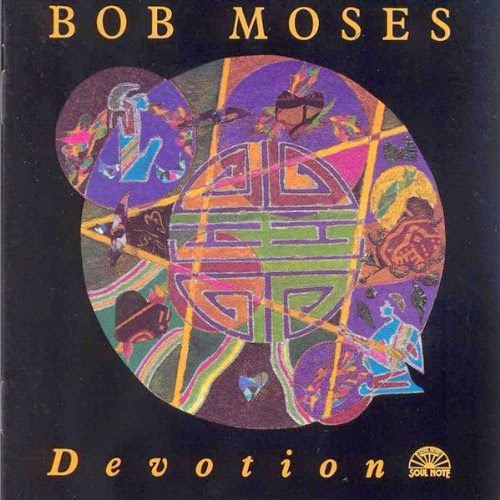
It turned out, somewhat
embarrassingly, that five of the tracks on Devotion had been released already
on an out-of-print 1980 LP titled Family on the small Sutra Records label. Soul
Note learned this when a reviewer pointed it out. Within a few years, expanded
use of the internet would make such an error much less likely to occur.
The band here is Moses
(drums/percussion), David Liebman (soprano saxophone), Terumasa Hino (cornet,
percussion), Steve Kuhn (piano), and Steve Swallow (bass).
Issuing the early work of a jazz musician 17 years after it was recorded carries with it a heavy burden of expectation and responsibility. The musician better be somebody of stature, or his historic document will be dismissed with a simple "so what?" or worse (anybody remember the critical reaction to Harry Connick Jr.'s album of his work as an 11-year-old? Ouch!) And the music better be of more than scholarly interest, or it will speak only to a small coterie. The tapes that Bob Moses's father found in his basement pass both these acid tests easily.
Multi-instrumentalist Bob Moses, born in New York City in 1948, was playing piano, vibes, and drums when he was ten years old and within two years was jamming with Charles Mingus, who was one of his press agent father's clients. He paid his dues as a teenage vibraphonist in the Big Apple's thriving Latin music scene and at the age of 18 formed what many consider the first electric jazz-rock group, Free Spirits (which included Jim Pepper and Larry Coryell). He subsequently played in a wide variety of jazz contexts with David Liebman's Open Sky, various Gary Burton groups, Jack DeJohnette, Pat Metheny, Hal Galper and the Brecker Brothers, and large groups led by Mike Gibbs and George Gruntz, among others. When Gramavision released 1982's When Elephants Dream of Music and 1983's Visit with the Great Spirit, they brought Moses critical acclaim and a broad audience. Yet he has recorded only intermittently since then, partly because he's been expanding his musical palette with trips abroad.
Thus, previously unheard music by Moses is even more welcome for mitigating the paucity of releases. But this album may be a revelation for those who know his music only from the later releases, which tend to be for large ensembles and of polyglot style. To say the quintet documented here is an all-star aggregation is not to engage in hyperbole, but merely to state the obvious. The talents of the players are given much more space than Moses's subsequent large-group works generally afford, and the context is at first glance more traditional, but the search for new sounds and structures found in the later works is already evident here; it's obvious at every turn that this was no jam session, but rather a carefully arranged date.
Thoughout this album, compositions unfold in a highly organic manner, with each section flowing into the next without obvious demarcations. It's as though, having decided that the tonal colors of the instruments and the styles of the players offer contrast enough, Moses wove his music from strands rather than building it from blocks. Jazz references name-check Gil Evans, Miles Davis, Charles Mingus, Duke Ellington, Thelonious Monk, and other bandleaders as influences on Moses's arranging, comparisons aiming obviously at Moses's large-group work; this quintet suggests that, structurally and developmentally, the subtle free jazz Jimmy Giuffre conceived in a trio format (to which Swallow was a major contributor) may have pointed towards some of the paths Moses travels down here, though the compositions are more worked out and a harmonic underpinning is almost always in evidence even if not always the governing feature.
"Autumn Liebs" is unsurprisingly a feature for Liebman, who solos first and longest; what is a surprise is that he's on tenor saxophone (as he is throughout the album) rather than on soprano sax. In fact, in the year following this recording he gave up tenor and flute to concentrate on the straight horn. His active (but not cluttered) style on this tune belies the accusation of Coltrane-clone often flung at his tenor work, covering a much broader bop and post-bop range in a thoroughly integrated way. Hino follows with a solo that seems ruminative even during its most expostulative outbursts and high-altitude moments; the longer it goes on, the more fragmentary his lines, lending a questioning quality, until Hino's phrases become so short that when Moses fills in the gaps with accents, it seems as though the two musicians are trading off. Kuhn's high-octane swirls follow in an effective contrast, and when the piece's hesitant theme returns, Kuhn underlines it with gusts and flurries.
"Heaven" is a ballad with an unusual structure: cornet and sax play the theme in unison, then repeat it with the tenor gradually diverging more to echo and comment. When Hino solos, Liebman continues to interject, as though the theme-and-divergence method were being continued, though by the second chorus it's Kuhn rather than Liebman who fills in the gaps. When Kuhn's solo begins, the effect at first is as if Hino has merely paused a bit longer. Kuhn's solo gradually becomes fuller, with his bright right-hand roulades balanced by weighty comping by the left hand, until Hino and Liebman return with the theme over Kuhn's most ornate runs. It is a highly organic arrangement that thoughtfully avoids the predictability and compartmentalization of head-instrument 1 solo-instrument 2 solo-instrument 3 solo-head structures.
The uptempo "Radio" has the merest excuse of a theme, its main characteristic being its asymmetrical phrase lengths and seemingly abrupt conclusion. In fact, it's a perfectly typical 32-bar length, but the ever-shifting phrase lengths with their unexpected pauses and extensions will throw listeners off-balance even on repeated hearings. Rising out of the absence of theme, Swallow steps to the fore for the first time, and then Hino plays his most fiery runs yet. The solos are not long, and after a typically bravura Kuhn excursion, Liebman charges in to top him. Throughout, Moses swings hard and fast, and after Hino spices the end of Liebman's solo, the theme gets played twice in a more assertive and less disconcerting fashion.
The oddly titled "Snake and Pygmy Pie" lays out a modal groove mostly carried by Swallow's ostinato pattern, with a sinister cornet/tenor melody full of pregnant pauses twining through Kuhn's spare Orientalisms while Moses plays a very free pulse. The textures are pared down even further when Swallow and Kuhn drop out, with Liebman and Hino trading figures which are more gestures than phrases, often overlapping, while Moses shifts the rhythm constantly. When the horns drop out, Kuhn and Swallow re-enter, both playing the ostinato figure, while Moses solos (a welcome change from the usual unaccompanied nature of drum solos). A lengthier and more elaborate variation on the style of the beginning turns into a coda that conjures the icy elegance of some of the quieter moments of electric-period Miles (a former employer of Liebman and an obvious influence on Hino, who on open cornet often manages to evoke a Harmon mute sound) with utterly different materials and procedures.
On "St. Elmo" (a reference to underappreciated bebop pianist/composer Elmo Hope, perhaps?), Hino finally does use a mute, recalling Miles's Prestige years. The piece seems continually to come to a close even in its earliest segments, yet keeps starting up again. The gorgeous ballad features Hino for quite a while until Kuhn takes over briefly with a strangely swirling line in which every accent is placed with lapidary precision, like Monk playing a Bill Evans tune. The oddly coda-like character of the entire piece, with Liebman entering late and Hino's fragile tone so predominant, leaves an elegaic impression at the same time it continually unsettles expectations; when it finally does cease to start up again, the effect is breathtaking.
The speedy "Portsmouth Figuration" has another odd, and quite short, head, with a few note-filled snippets of varying lengths alternating with brief, frenetic solos, with Swallow's trotting (this is too fast for walking) and Moses's headlong rush of a cymbal beat holding it together. Hino again plays fragmentary lines during most of his short solo, contrasting strongly with the robust, perpetual-motion lines Liebman spins out next. Moses then takes an unaccompanied solo of JATP-like proportions, shifting kaleidoscopically through a variety of patterns spiced up with some percussion sounds definitely not found in a standard drum kit. Through all the pauses and twists, his momentum never flags until he fades out before the oh-so-brief reappearance of the instruments.
The melody of "Christmas '78" is awfully nostalgic, in a fairly melancholic if hardly depressed tone, for a holiday a mere eight months past at the time of recording. Though Kuhn's comping under Hino's solo, along with Swallow's rhythm, is sometimes quite jaunty, it alternates with a foreboding modal pattern utterly lacking in cheer. Hino's improvisations here are much more of a piece than elsewhere on the album, and within a relatively narrow range. Similarly, Kuhn's solo is at first more restrained and less overtly virtuosic than his established norm on the other tracks. He takes us through a series of juxtaposed moods ranging from chirpy to ironic, all seemingly with quotes around them. Liebman's pensive, Shorteresque solo has an elliptical quality that leads into a unison restatement with Hino of the regret-laden theme.
Hino opens "Devotion" by himself in his most heart-wrenching tone, developing the nagging motif with some mildly avant timbres before returning to his plushly mellow tone. Swallow takes over with a minimal, broadly paced ostinato just barely accompanied by Moses, leading finally to the theme. A regal melody laid out in long notes, it has a flavor of archaic majesty to it that all the players emphasize as they simultaneously embroider it, slowly crescendoing in volume and intensity. The title helps suggest a sort of ritualistic worshipfulness, and the ever-increasing fervor of the players suggests this devotion brings with it an ecstasy surpassing verbal expression. Kuhn in particular utterly submerges his florid tendencies in a chiming procession of block chords. The bends and tonal inflections of Hino and the plangent, mournful sound Liebman draws from his horn, which eventually is stripped down to a long held tone, give way to Swallow's final statement of the ostinato and then to silence. It is the most organic and elliptical of all Moses's arrangements on this masterful session, and its hushed rather than bravura ending, like all of them, heeds conventional ideas only to quietly subvert them. Here's hoping Richard Moses finds some more tapes in his basement.
Issuing the early work of a jazz musician 17 years after it was recorded carries with it a heavy burden of expectation and responsibility. The musician better be somebody of stature, or his historic document will be dismissed with a simple "so what?" or worse (anybody remember the critical reaction to Harry Connick Jr.'s album of his work as an 11-year-old? Ouch!) And the music better be of more than scholarly interest, or it will speak only to a small coterie. The tapes that Bob Moses's father found in his basement pass both these acid tests easily.
Multi-instrumentalist Bob Moses, born in New York City in 1948, was playing piano, vibes, and drums when he was ten years old and within two years was jamming with Charles Mingus, who was one of his press agent father's clients. He paid his dues as a teenage vibraphonist in the Big Apple's thriving Latin music scene and at the age of 18 formed what many consider the first electric jazz-rock group, Free Spirits (which included Jim Pepper and Larry Coryell). He subsequently played in a wide variety of jazz contexts with David Liebman's Open Sky, various Gary Burton groups, Jack DeJohnette, Pat Metheny, Hal Galper and the Brecker Brothers, and large groups led by Mike Gibbs and George Gruntz, among others. When Gramavision released 1982's When Elephants Dream of Music and 1983's Visit with the Great Spirit, they brought Moses critical acclaim and a broad audience. Yet he has recorded only intermittently since then, partly because he's been expanding his musical palette with trips abroad.
Thus, previously unheard music by Moses is even more welcome for mitigating the paucity of releases. But this album may be a revelation for those who know his music only from the later releases, which tend to be for large ensembles and of polyglot style. To say the quintet documented here is an all-star aggregation is not to engage in hyperbole, but merely to state the obvious. The talents of the players are given much more space than Moses's subsequent large-group works generally afford, and the context is at first glance more traditional, but the search for new sounds and structures found in the later works is already evident here; it's obvious at every turn that this was no jam session, but rather a carefully arranged date.
Thoughout this album, compositions unfold in a highly organic manner, with each section flowing into the next without obvious demarcations. It's as though, having decided that the tonal colors of the instruments and the styles of the players offer contrast enough, Moses wove his music from strands rather than building it from blocks. Jazz references name-check Gil Evans, Miles Davis, Charles Mingus, Duke Ellington, Thelonious Monk, and other bandleaders as influences on Moses's arranging, comparisons aiming obviously at Moses's large-group work; this quintet suggests that, structurally and developmentally, the subtle free jazz Jimmy Giuffre conceived in a trio format (to which Swallow was a major contributor) may have pointed towards some of the paths Moses travels down here, though the compositions are more worked out and a harmonic underpinning is almost always in evidence even if not always the governing feature.
"Autumn Liebs" is unsurprisingly a feature for Liebman, who solos first and longest; what is a surprise is that he's on tenor saxophone (as he is throughout the album) rather than on soprano sax. In fact, in the year following this recording he gave up tenor and flute to concentrate on the straight horn. His active (but not cluttered) style on this tune belies the accusation of Coltrane-clone often flung at his tenor work, covering a much broader bop and post-bop range in a thoroughly integrated way. Hino follows with a solo that seems ruminative even during its most expostulative outbursts and high-altitude moments; the longer it goes on, the more fragmentary his lines, lending a questioning quality, until Hino's phrases become so short that when Moses fills in the gaps with accents, it seems as though the two musicians are trading off. Kuhn's high-octane swirls follow in an effective contrast, and when the piece's hesitant theme returns, Kuhn underlines it with gusts and flurries.
"Heaven" is a ballad with an unusual structure: cornet and sax play the theme in unison, then repeat it with the tenor gradually diverging more to echo and comment. When Hino solos, Liebman continues to interject, as though the theme-and-divergence method were being continued, though by the second chorus it's Kuhn rather than Liebman who fills in the gaps. When Kuhn's solo begins, the effect at first is as if Hino has merely paused a bit longer. Kuhn's solo gradually becomes fuller, with his bright right-hand roulades balanced by weighty comping by the left hand, until Hino and Liebman return with the theme over Kuhn's most ornate runs. It is a highly organic arrangement that thoughtfully avoids the predictability and compartmentalization of head-instrument 1 solo-instrument 2 solo-instrument 3 solo-head structures.
The uptempo "Radio" has the merest excuse of a theme, its main characteristic being its asymmetrical phrase lengths and seemingly abrupt conclusion. In fact, it's a perfectly typical 32-bar length, but the ever-shifting phrase lengths with their unexpected pauses and extensions will throw listeners off-balance even on repeated hearings. Rising out of the absence of theme, Swallow steps to the fore for the first time, and then Hino plays his most fiery runs yet. The solos are not long, and after a typically bravura Kuhn excursion, Liebman charges in to top him. Throughout, Moses swings hard and fast, and after Hino spices the end of Liebman's solo, the theme gets played twice in a more assertive and less disconcerting fashion.
The oddly titled "Snake and Pygmy Pie" lays out a modal groove mostly carried by Swallow's ostinato pattern, with a sinister cornet/tenor melody full of pregnant pauses twining through Kuhn's spare Orientalisms while Moses plays a very free pulse. The textures are pared down even further when Swallow and Kuhn drop out, with Liebman and Hino trading figures which are more gestures than phrases, often overlapping, while Moses shifts the rhythm constantly. When the horns drop out, Kuhn and Swallow re-enter, both playing the ostinato figure, while Moses solos (a welcome change from the usual unaccompanied nature of drum solos). A lengthier and more elaborate variation on the style of the beginning turns into a coda that conjures the icy elegance of some of the quieter moments of electric-period Miles (a former employer of Liebman and an obvious influence on Hino, who on open cornet often manages to evoke a Harmon mute sound) with utterly different materials and procedures.
On "St. Elmo" (a reference to underappreciated bebop pianist/composer Elmo Hope, perhaps?), Hino finally does use a mute, recalling Miles's Prestige years. The piece seems continually to come to a close even in its earliest segments, yet keeps starting up again. The gorgeous ballad features Hino for quite a while until Kuhn takes over briefly with a strangely swirling line in which every accent is placed with lapidary precision, like Monk playing a Bill Evans tune. The oddly coda-like character of the entire piece, with Liebman entering late and Hino's fragile tone so predominant, leaves an elegaic impression at the same time it continually unsettles expectations; when it finally does cease to start up again, the effect is breathtaking.
The speedy "Portsmouth Figuration" has another odd, and quite short, head, with a few note-filled snippets of varying lengths alternating with brief, frenetic solos, with Swallow's trotting (this is too fast for walking) and Moses's headlong rush of a cymbal beat holding it together. Hino again plays fragmentary lines during most of his short solo, contrasting strongly with the robust, perpetual-motion lines Liebman spins out next. Moses then takes an unaccompanied solo of JATP-like proportions, shifting kaleidoscopically through a variety of patterns spiced up with some percussion sounds definitely not found in a standard drum kit. Through all the pauses and twists, his momentum never flags until he fades out before the oh-so-brief reappearance of the instruments.
The melody of "Christmas '78" is awfully nostalgic, in a fairly melancholic if hardly depressed tone, for a holiday a mere eight months past at the time of recording. Though Kuhn's comping under Hino's solo, along with Swallow's rhythm, is sometimes quite jaunty, it alternates with a foreboding modal pattern utterly lacking in cheer. Hino's improvisations here are much more of a piece than elsewhere on the album, and within a relatively narrow range. Similarly, Kuhn's solo is at first more restrained and less overtly virtuosic than his established norm on the other tracks. He takes us through a series of juxtaposed moods ranging from chirpy to ironic, all seemingly with quotes around them. Liebman's pensive, Shorteresque solo has an elliptical quality that leads into a unison restatement with Hino of the regret-laden theme.
Hino opens "Devotion" by himself in his most heart-wrenching tone, developing the nagging motif with some mildly avant timbres before returning to his plushly mellow tone. Swallow takes over with a minimal, broadly paced ostinato just barely accompanied by Moses, leading finally to the theme. A regal melody laid out in long notes, it has a flavor of archaic majesty to it that all the players emphasize as they simultaneously embroider it, slowly crescendoing in volume and intensity. The title helps suggest a sort of ritualistic worshipfulness, and the ever-increasing fervor of the players suggests this devotion brings with it an ecstasy surpassing verbal expression. Kuhn in particular utterly submerges his florid tendencies in a chiming procession of block chords. The bends and tonal inflections of Hino and the plangent, mournful sound Liebman draws from his horn, which eventually is stripped down to a long held tone, give way to Swallow's final statement of the ostinato and then to silence. It is the most organic and elliptical of all Moses's arrangements on this masterful session, and its hushed rather than bravura ending, like all of them, heeds conventional ideas only to quietly subvert them. Here's hoping Richard Moses finds some more tapes in his basement.


